📖 Dua-e-Hizbul Bahr Sharif – Complete Roman English, Benefits, Fazail & Reading Guide
Dua-e-Hizbul Bahr Sharif – Complete Roman English, Benefits, Fazail & Reading Guide
Dua-e-Hizbul Bahr, also known as Hizb al-Bahr, is a famous Islamic litany attributed to Imam Abu al-Hasan Ali al-Shadhili رحمه الله, the renowned spiritual master associated with the Shadhili tradition. The word Hizb refers to a litany or collection of supplications, while Bahr means “sea.” Thus, Hizbul Bahr is commonly translated as “The Litany of the Sea.”
The dua contains supplications seeking Allah’s help, protection, mercy, forgiveness, guidance, provision, safety and ease. It also includes several Qur’anic verses and expressions of reliance upon Allah.
Classical and later Shadhili sources have given considerable attention to Hizbul Bahr. One important work is Sharh Hizb al-Bahr by Imam Ahmad Zarruq رحمه الله, while Lata’if al-Minan by Ibn Ata’illah al-Iskandari رحمه الله is also cited in discussions concerning its regular recitation.
Who Wrote Hizbul Bahr?
Hizbul Bahr is traditionally attributed to Imam Abu al-Hasan Ali al-Shadhili رحمه الله. It became one of the best-known awrad associated with the Shadhili spiritual tradition and continues to be recited by Muslims in different parts of the world.
The traditional Shadhili sources describe Hizbul Bahr as a litany composed of Qur’anic passages and supplications, with themes of tawakkul, protection, divine assistance and complete dependence upon Allah.
What Does Hizbul Bahr Mean?
The name Hizbul Bahr literally means “The Litany of the Sea.”
The name is connected with the supplication:
“Wa sakhkhir lana hadha al-bahr…”
meaning, in general, to ask Allah to subject the sea and all that is under His dominion to His servant’s benefit and protection.
The dua repeatedly reminds the reader that all power, dominion, protection and assistance belong to Allah alone.
Fazail Aur Riwayati Benefits of Hizbul Bahr
Hizbul Bahr contains numerous supplications for protection, help, forgiveness, guidance, provision and ease. Classical Shadhili commentaries also discuss spiritual benefits associated with its recitation.
1. Seeking Allah’s Help and Victory
One of the central themes of Hizbul Bahr is asking Allah for help:
Unṣurnā fa-innaka khayru n-nāṣirīn
The meaning is that the servant asks Allah for help because Allah is the best of those who grant victory.
The dua then asks Allah for opening, forgiveness, mercy, provision and guidance.
This makes seeking Allah’s assistance one of the most prominent themes of Hizbul Bahr.
2. Protection and Safety
Protection is another major theme of the Hizb.
The dua contains requests for protection from enemies, harm, fear and difficulties. It also asks Allah to surround the servant with His protection and care.
A traditional account associated with Hizbul Bahr states that Shaykh Abu al-Hasan al-Shadhili رحمه الله described it as containing a great Divine Name and spoke of security associated with its recitation. This account is preserved in Shadhili literature and later commentaries.
This should be presented as a traditional report associated with the Shadhili tradition, rather than automatically treating every detail of the report as a rigorously authenticated Hadith.
3. Relief From Difficulties
Hizbul Bahr repeatedly asks Allah to make matters easy:
Allahumma yassir lana umurana…
The supplication asks Allah for ease, comfort, safety and well-being in matters concerning one’s heart and body.
Therefore, one of the main spiritual themes of Hizbul Bahr is turning to Allah during difficulties and asking Him for relief and ease.
4. Provision and Rizq
The Hizb contains:
Warzuqna fa-innaka khayru r-raziqin
This means:
“Provide for us, for You are the best of providers.”
Thus, asking Allah for provision is explicitly included in the text of Hizbul Bahr itself.
5. Protection During Travel
Hizbul Bahr contains the following supplication:
Wa-kun lana sahiban fi safarina wa-khalifatan fi ahlina.
It asks Allah to be a companion during travel and a caretaker of one’s family.
Because of this wording, travel and protection are important themes within the dua.
6. Safety and Well-Being in Religion and Worldly Life
The Hizb asks Allah for:
as-salamah wal-‘afiyah
and specifically mentions safety and well-being in religion, worldly life and the Hereafter.
This makes the dua comprehensive: it does not ask only for worldly benefit but seeks well-being in Deen, Dunya and Akhirah.
7. Tawakkul and Reliance Upon Allah
Hizbul Bahr teaches the heart to depend upon Allah.
The opening itself emphasizes:
Anta Rabbi wa ‘ilmuka hasbi
meaning that Allah is the Lord and His knowledge is sufficient.
The overall structure of the Hizb repeatedly returns the reader to Allah’s power, mercy, knowledge, protection and dominion.
Ahmad Zarruq’s commentary particularly discusses Hizbul Bahr in terms of trust, surrender and reliance upon Allah.
8. Spiritual Strength and Inner Reassurance
Because the dua contains repeated requests for Allah’s protection, mercy, guidance and assistance, its recitation can serve as a means of turning one’s heart toward Allah.
It should, however, be understood as a dua and wird, not as a magical formula. A useful explanation of Hizbul Bahr emphasizes that its purpose includes developing presence of heart, dependence upon Allah and sincere supplication.
When Should Hizbul Bahr Be Read?
There are different practices regarding the time of recitation.
Ibn Ata’illah al-Iskandari رحمه الله is cited in discussions of Hizbul Bahr as saying that it is a wird to be recited after the ‘Asr prayer, while another major litany is associated with the time after Fajr. Ahmad Zarruq also discusses this in his commentary.
Some traditional sources also mention reciting Hizbul Bahr at sunrise, while other people recite it when they have a particular need and make an intention during the relevant portion of the Hizb.
Therefore, if you are following a particular Shaykh, Tariqah or authorized wird schedule, it is best to follow that established method rather than assuming that one schedule applies universally.
Important Note About Different Versions of Hizbul Bahr
Readers may notice that the Arabic text of Hizbul Bahr can differ slightly between books and websites.
For example, one widely circulated Shadhili version begins with:
Ya Aliyyu, Ya Azimu, Ya Halimu, Ya Alimu…
while the version supplied for this article begins:
Ya Allahu, Ya Aliyyu, Ya Azimu, Ya Halimu, Ya Alimu…
There are also differences in the inclusion and arrangement of introductory or concluding passages in some South Asian printed editions. A scholarly discussion notes that some Indian editions contain additional introductory and concluding material that is not found in every transmission of the Hizb.
For this reason, it is better to identify the specific edition or transmission being followed rather than mixing lines from different versions.
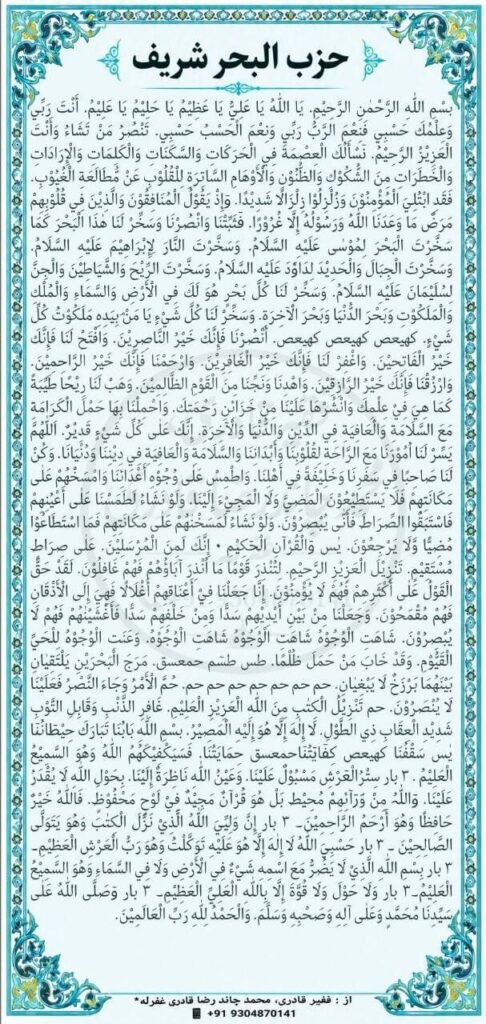
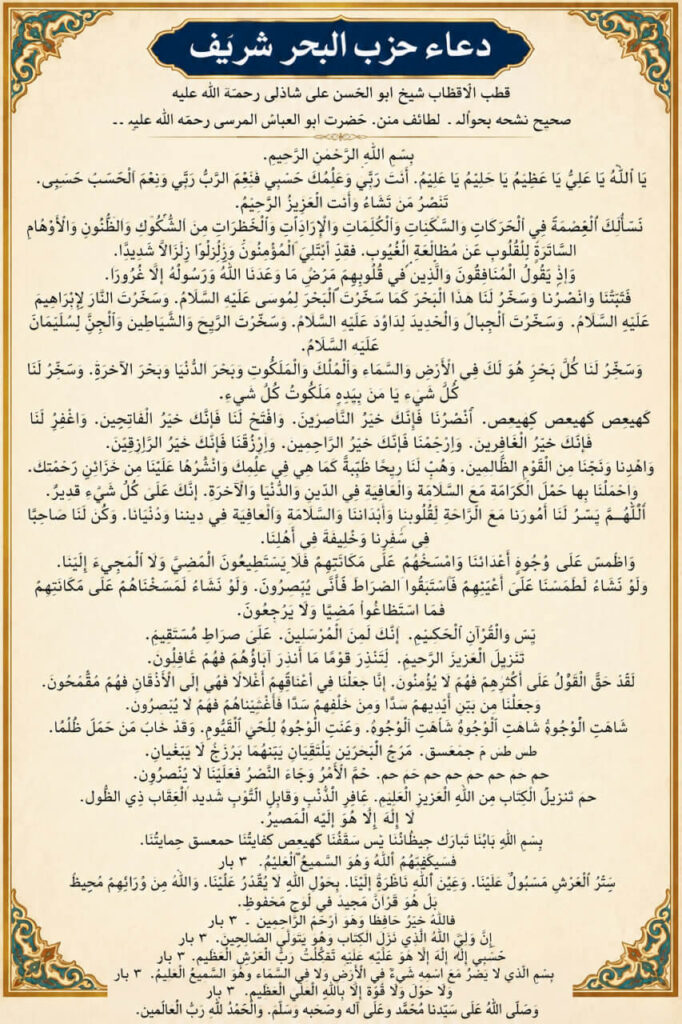
📖 Dua-e-Hizbul Bahr Sharif – Complete Roman English
Dua-e-Hizbul Bahr Sharif
Qutb-ul-Aqtab Sheikh Abu al-Hasan Ali Shadhili Rahmatullahi Alaih
Sahih Nuskha Bahawala: Lataif-e-Minan, Hazrat Abu al-Abbas al-Mursi Rahmatullahi Alaih
Bismillahir-Rahmanir-Raheem.
Ya Allahu, Ya Aliyyu, Ya Azeemu, Ya Haleemu, Ya Aleemu. Anta Rabbi wa ilmuka hasbi, fa-ni’mar-Rabbu Rabbi wa ni’mal-hasbu hasbi. Tansuru man tasha’u wa antal-Azeezur-Raheem.
Nas’alukal-‘ismata fil-harakati was-sakanati wal-kalimati wal-iradati wal-khataraati minash-shukooki waz-zunooni wal-awhaamis-saatirati lil-quloobi ‘an mutaalatil-ghuyub. Faqadibtuliyal-mu’minoona wa zulziloo zilzalan shadeeda.
Wa-iz yaqoolul-munafiqoona wallazeena fee quloobihim maradun maa wa’adanallahu wa Rasooluhu illa ghuroora.
Fa-thabbitna wansurna wa sakhkhir lana haazal-bahra kama sakhkhartal-bahra li-Moosa alayhis-salaam. Wa sakhkhartan-naara li-Ibraheema alayhis-salaam. Wa sakhkhartal-jibaala wal-hadeeda li-Dawooda alayhis-salaam. Wa sakhkhartar-reeha wash-shayateena wal-jinna li-Sulaymaana alayhis-salaam.
Wa sakhkhir lana kulla bahrin huwa laka fil-ardi was-samaai wal-mulki wal-malakooti wa bahrad-dunya wa bahr al-aakhirah. Wa sakhkhir lana kulla shai’in ya man biyadihi malakootu kulli shai’.
Kaaf Haa Yaa Ain Saad, Kaaf Haa Yaa Ain Saad, Kaaf Haa Yaa Ain Saad.
Un-surna fa-innaka khairun-naasireen. Wa-ftah lana fa-innaka khairul-faatiheen. Waghfir lana fa-innaka khairul-ghaafireen. Warhamna fa-innaka khairur-raahimeen. Warzuqna fa-innaka khairur-raaziqeen.
Wahdina wa najjina minal-qawmiz-zaalimeen. Wa hab lana reehan tayyibatan kama hiya fee ilmika, wanshurha alaina min khazaa’ini rahmatika. Wahmilna biha hamlal-karaamati ma’as-salaamati wal-‘aafiyati fid-deeni wad-dunya wal-aakhirah. Innaka ala kulli shai’in qadeer.
Allahumma yassir lana umoorana ma’ar-raahati liquloobina wa-abdaana was-salaamati wal-‘aafiyati fee deenina wa dunyana. Wa kun lana saahiban fee safarina wa khaleefatan fee ahlina.
Watmis ala wujoohi a’daa’ina wamsakh-hum ala makaanatihim fala yastatee’oona al-madiyya wa lal-majee’a ilaina.
Wa law nashaa’u latamasna ala a’yunihim fastabaqus-siraata fa-anna yubsiroon. Wa law nashaa’u lamasakhnaahum ala makaanatihim fama istata’oo mudiyyan wa la yarji’oon.
Ya Seen wal-Qur’aanil-Hakeem. Innaka laminal-mursaleen. Ala siraatim-mustaqeem. Tanzeelal-Azeezir-Raheem. Litunzira qawman maa unzira aabaa’uhum fahum ghaafiloon.
Laqad haqqal-qawlu ala aksarihim fahum la yu’minoon. Inna ja’alna fee a’naaqihim aghlaalan fahiya ilal-azqaani fahum muqmahoon. Wa ja’alna mim baini aideehim saddan wa min khalfihim saddan fa-aghshainaahum fahum la yubsiroon.
Shaahatil-wujooh, Shaahatil-wujooh, Shaahatil-wujooh.
Wa anatil-wujoohu lil-Hayyil-Qayyoom. Wa qad khaaba man hamala zulma.
Taa Seen, Taa Seen Meem, Haa Meem, Ain Seen Qaaf.
Marajal-bahraini yaltaqiyaan. Bainahuma barzakhul-la yabghiyaan.
Haa Meem, Haa Meem, Haa Meem, Haa Meem, Haa Meem, Haa Meem, Haa Meem.
Hummal-amru wa jaa’an-nasru fa-alaina la yunsaroon.
Haa Meem. Tanzeelul-kitaabi minallahil-Azeezil-Aleem. Ghaafiriz-zanbi wa qaabilit-tawbi shadeedil-‘iqaabi zit-tawl. La ilaaha illa Huwa ilaihil-maseer.
Bismillahi baabuna. Tabaaraka heetaanuna. Ya Seen saqfuna. Kaaf Haa Yaa Ain Saad kifaa-ayatuna. Haa Meem Ain Seen Qaaf himaayatuna.
Fa-sayakfeekahumullahu wa Huwas-Samee’ul-Aleem. 3 baar
Sitrul-‘Arshi masboolun alaina. Wa ainullahi naaziratun ilaina. Bi-hawlillahi la yuqdaru alaina. Wallahu min waraa’ihim muheet. Bal huwa Qur’aanum-Majeedun fee lauhim-mahfooz.
Fallahu khairun haafizan wa Huwa Arhamur-Raahimeen. 3 baar
Inna waliyyiyallahu allazee nazzalal-kitaaba wa Huwa yatawallas-saaliheen. 3 baar
Hasbiyallahu la ilaaha illa Huwa. Alaihi tawakkaltu wa Huwa Rabbul-Arshil-Azeem. 3 baar
Bismillahillazee la yadurru ma’as-mihi shai’un fil-ardi wa la fis-samaa’i wa Huwas-Samee’ul-Aleem. 3 baar
Wa la hawla wa la quwwata illa billahil-Aliyyil-Azeem. 3 baar
Wa sallallahu ala Sayyidina Muhammadin wa ala aalihi wa sahbihi wa sallam.
Walhamdu lillahi Rabbil-Aalameen.
📖 A Few Important Points While Reading Hizbul Bahr
Hizbul Bahr contains Qur’anic verses, Divine Names and supplications. Therefore, it should be read with adab, attention and sincerity.
The purpose should be to ask Allah alone for help, protection, forgiveness, mercy, guidance and well-being.
It is also important not to treat the Hizb as a magical formula. The spiritual literature surrounding Hizbul Bahr emphasizes intention, presence of heart, reliance upon Allah and consistency in one’s wird.
If someone follows a specific Shadhili or other authorized wird practice, they should follow the instructions of their teacher regarding the time, number and method of recitation.
References and Further Reading
- Lata’if al-Minan — Imam Ibn Ata’illah al-Iskandari رحمه الله, cited in discussions concerning the timing of Hizbul Bahr.
- Sharh Hizb al-Bahr — Imam Ahmad Zarruq رحمه الله, a major commentary explaining the spiritual meanings and method of Hizbul Bahr.
- Hizb al-Bahr of Imam Abu al-Hasan al-Shadhili — Arabic text and traditional Shadhili material.
- Salawat.com – Hizbul Bahr — Arabic, transliteration, translation and discussion of traditional recitation practices.
Dua-e-Hizbul Bahr Sharif – Hizbul Bahr Dua in Roman English, Hindi & Urdu | دعائے حزب البحر شریف